HVAC planned preventative maintenance

HVAC planned preventative maintenance (PPM) comprises of service checks on all parts of plant and equipment, to confirm their correct operation. Plant and equipment items in a HVAC system include, heating, ventilation and air conditioning, as well as connected systems, such as water services and building energy management systems (BEMS).
HVAC planned preventative maintenance and service checks include: verification of efficient operation, health and safety measures, examination of critical components, appropriate discharge inspection and analysis of operation parameters, such as, noises and vibrations. Servicing is important insofar as systems are checked for deterioration and do not put people or business operations at undue risk – protecting the capital value of your plant.
Scheduling of PPM visits are carried out in accordance with manufacturer’s recommendations and in agreement with your own business specific requirements.
Competent service engineers
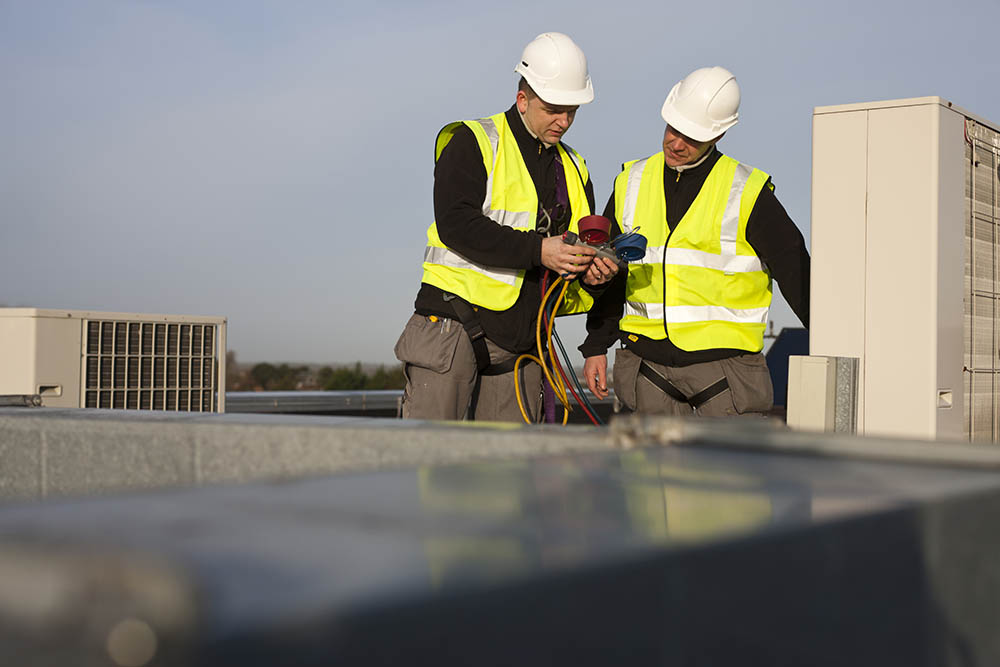
HVAC PPM must be provided by service engineers, appropriately attired in personal protective equipment (PPE). Service engineers must be competently trained and certified to carry out all works. To begin with, a training apprenticeship should be undertaken to national craft certificate standard – in electrical, plumbing or refrigeration and air conditioning. Then industry competencies can be added after apprenticeship achievement.
For heating systems, a competent person must be registered with the Register of Gas Installers, Ireland (RGII) | search the register
For air conditioning systems, a competent person must be registered with F-Gas Registration (FGR) | find a certified company
In carrying out PPM, the first step is for the service engineers to furnish building facility managers or others with work method statements and conduct a site risk assessment. These document site-specific hazards, working risks and their associated control measures.
Secondly, service engineers must apply asset labels and asset tag all HVAC, water and BEMS plant items. This provides traceability, tying all service, maintenance and repair activity back to each individual asset item, via a unique number.
Ideally, all activity history should be recorded in a computerised maintenance management system (CMMS) for ease of record retrieval. If not, a logbook should be created, with records retained to comply with industry standards.
A CMMS also provides transparency in ensuring only engineers’ working hours associated with particular jobs are charged, by automatically connecting work performed with specific customer accounts.
HVAC PPM benefits
The benefits to performing PPM are threefold.
1. Improved reliability
PPM provides proof of efficient working order of plant items, protecting your capital investment. It also identifies repairs that may be needed before a breakdown occurs, ensuring maximum uptime of the plant, giving you peace-of-mind. Benefits also include, cleaner air from ventilation and air conditioning, utilisation of control equipment and enhanced comfort conditions.
2. Compliance
Compliance with all health and safety and legal requirements. This compliance will also assist in the event of audits by statutory bodies, such as, the Health and Safety Authority (HSA) or the Environmental Protection Agency (EPA).
3. Energy efficiency
Optimisation of efficiency through the harmonious operation of the HVAC system and connected water services and BEMS plant. A well-balanced system operating to optimal levels can highlight waste and provide closer control of the work environment.
Implications of no PPM
HVAC systems that are not maintained are at a greater risk of failure, due to the lack of attention, verification checks and general care. This can cause:
1. Operations downtime
HVAC systems, water services and BEMS may directly or indirectly feed into your production or business operation supply chain. Therefore, the care and attention of PPM is required. Without service and maintenance, business operations could incur unwanted downtime for repairs, costing you money and damaging to your brand’s reputation.
2. Uncomfortable conditions – increased complaints
Increased complaints from staff, customers and visitors alike can lead to industrial relations issues and reputational damage amongst stakeholders. Unmaintained systems may not operate within desired design parameters to the comfort satisfaction of building occupants – be it too hot or too cold.
3. Health and safety and compliance failures
Audit failure with statutory bodies could lead to business closure or the issue of severe fines. Moreover, lack of attention to safety could cause injury or death, particularly in dealing with water systems, where pipework is vulnerable to Legionnaire’s disease. Improper competency in the installation of gas or electrical systems can also result in serious injury or death. While compliance audits on air conditioning systems are becoming more common place, as the EPA enforce EU F-Gas regulations and the phase down of harmful refrigerants.
Establishing a HVAC PPM regime
Setting up PPM will involve compiling an asset list of plant items for servicing. This will enable prospective PPM providers to offer a competitive quotation, while taking into consideration your businesses’ specific operational requirements.
HVAC PPM is provided to all businesses in all sectors who rely on heating, cooling, ventilation, water services and the management of BEMS controls. These businesses can range from data centres to hospitals and retail shops.
Thermodial’s approach
Thermodial’s approach to PPM is delivery through trustworthy, multi-skilled service engineers, who are flexible to your environment and specific service requirements. Multi-skilled service engineers have a higher level of training, which aids a first-time fix of issues. Multi-skilled service engineers, therefore, save time and money for customers, while reducing the chance of repeat callouts. On average, Thermodial spend a cumulative 4% of payroll costs on training per annum. This equates to six man-months’ work, comparing favourably with international standards.
Thermodial also offer 24/7 – 365 emergency callout cover on all PPM agreements, ensuring that any business-critical plant failure is immediately dealt with, whenever it happens.
Talk to Thermodial about preventative maintenance to support your businesses’ growth and critical needs.

Customer testimonials

Latest News

5 most common air conditioning problems and solutions
Air conditioning problems can occur in office and work environments, particularly over the summer cooling period. The following air conditioning problems are amongst the most common reported to our field service engineers and engineering staff. If they aren’t attended...

VIDEO: water system – ballcock failure danger
The water storage tank is an essential part of your building’s complete heating, ventilation, air conditioning (HVAC) and water services system. By extension, a ballcock is an essential component in the system, as its job is to regulate the water level in the tank....
From the news archives…
R22 refrigerant gas ban
An R22 refrigerant gas ban comes into effect on 01 January 2015. This will make it illegal to service (the gas section) of air conditioning units containing R22 from this date. What is R22? R22 refrigerant gas is a HCFC (hydro chlorofluorocarbon) or ozone depleting...
10 Top building service tips for winter
Ensure your building or work environment gets the protection it needs over the winter months. Below are ten of our top tips from observations and knowledge accrued over the years to help protect the services within your building. If you need any additional...
Maintain filters – save energy
Filters are an important protection measure for heating and cooling systems, providing occupants with comfort through climate control and a healthy environment. An area of concern from an energy spending point of view, if there is heating and cooling in your building,...
Summer air conditioning checks
The sun might not be shinning as bright as it was last weekend or indeed Monday (when one of our engineers recorded a temperature of 27°C on the roof of a building in Dublin 7), but high levels of humidity in the air are due to last right up until the weekend. If you...
Refrigerant responsibilities for air conditioning
Set out in 2009 by the European Commission, there are strict rules on the usage of gases in air-conditioning, heat pumps and refrigeration systems. Are you aware of the regulations and the responsible person for their enforcement? Below is an overview of the...
Talk To Thermodial
When Thermodial were founded in 1986, the founders had a vision of an engineering focused service, but also one that was responsive and reliable.
This belief should hold true to dealing with questions or information requests, such as one you may have.
Please contact us by filling in the form below, for a prompt response; email info@thermodial.ie or ring us in Dublin.
As the experts in HVAC maintenance, upgrades and energy management, we would be happy to respond to your requests.